
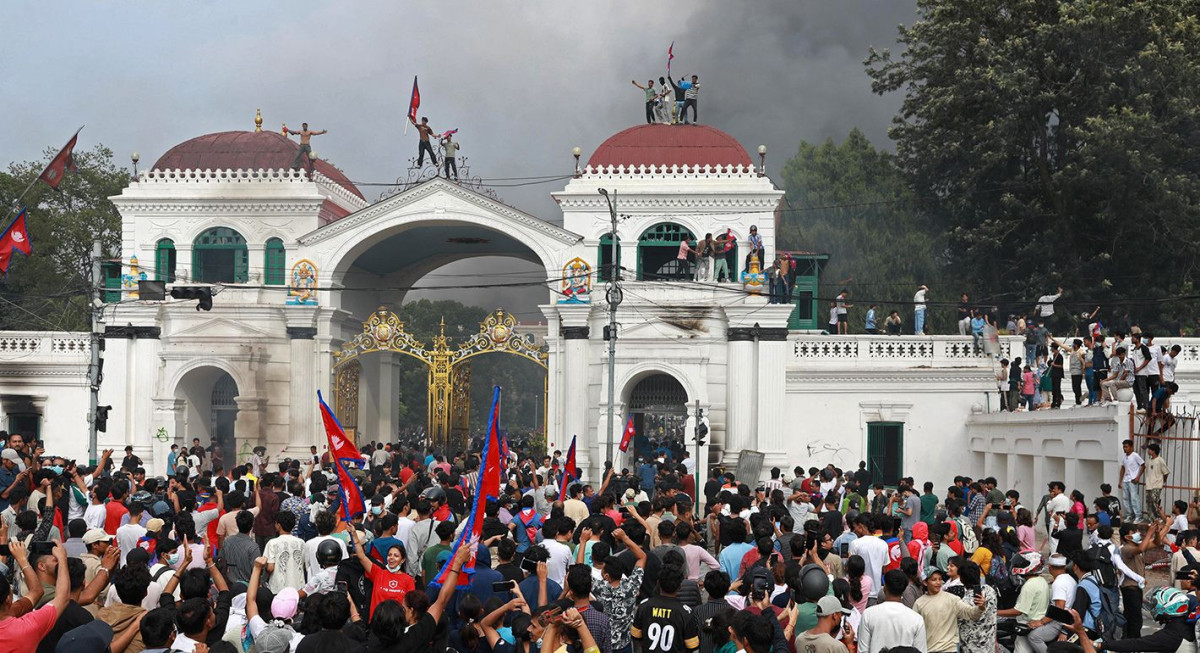
As the country has been under close public scrutiny for nearly two months since the historic Gen Z protest rocked Nepal, the government, political parties, and the young generation that spearheaded the uprising are under close public scrutiny. While the interim government is racing against time to hold the March 5 election to the House of Representatives, political parties are grappling with internal realignments, and the Gen Z movement itself faces the challenge of maintaining unity and purpose.
Ongoing Consultations
The interim government, born out of the September 8–9 Gen Z movement, has prioritized conducting the March 5 election as its key mandate. It has engaged in consultations with political parties, civil society, and Gen Z representatives to clarify its stance on good governance and electoral preparation.
Government spokesperson Jagadish Kharel said the government was encouraged by talks with both political actors and Gen Z representatives, noting that such discussions would help create a conducive environment for the election.
However, skepticism remains. Many political leaders who earlier dismissed the government as unconstitutional and undemocratic are now demanding firm guarantees of a free and fair election. The government, despite its efforts toward governance reforms, has yet to earn the full confidence of major political forces.
Initially torn between taking a hard line against political leaders and focusing on election preparations, the government gradually shifted to broader consultations to ease tensions. Prime Minister Sushila Karki, who had earlier expressed reservations about meeting top leaders, has now held dialogue with Nepali Congress General Secretaries Gagan Thapa and Bishwo Prakash Sharma, seeking their cooperation in ensuring successful elections.
Similarly, Home Minister Om Prakash Aryal met former President Dr. Ram Baran Yadav, who recalled the 2013 Constituent Assembly election held under the Khilraj Regmi-led government during another difficult transition. Dr. Yadav expressed confidence that the present civilian government, too, could lead the nation successfully through this testing phase.
For the government, the challenge lies in balancing Gen Z’s demands for accountability and reform with its constitutional obligation to hold elections on time - a delicate act that will define its legitimacy.
Hullabaloo or Shake-Up?
The political landscape, particularly among leftist parties, has been in turmoil since the Gen Z movement and the announcement of the March 5 polls. Eight left-oriented forces, including the CPN (Maoist Centre) and CPN (Unified Socialist), have agreed to unify under a new banner.
With Pushpa Kamal Dahal ‘Prachanda’ and Madhav Kumar Nepal emerging as the new leadership duo, several prominent leaders such as Jhalanath Khanal, Ghanashyam Bhusal, and Ram Kumari Jhankri find themselves sidelined, while Janardan Sharma of the Maoist Centre has announced a new internal campaign.
Though unification and division among communist parties are nothing new in Nepali politics, whether this latest upheaval leads to genuine ideological or structural change remains to be seen.
The Nepali Congress (NC), Nepal’s oldest democratic party, is also in the throes of internal conflict over leadership transition before the election. Party President Sher Bahadur Deuba, who was seriously injured during the September 9 protest, temporarily handed over his duties to Acting President Purna Bahadur Khadka. In his recent address, Deuba signaled willingness to step down but insisted that leadership change must occur through a democratic convention.
With the NC’s central committee divided - one camp favoring leadership change before the polls and another resisting it - the party remains mired in factional tension. General Secretaries Gagan Thapa and Bishwo Prakash Sharma continue to advocate for renewal, but Thapa faces criticism from establishment loyalists.
In both communist and democratic camps, leadership renewal has become the elephant in the room - widely discussed, but rarely acted upon. Whether second and third-rung leaders will rise to the occasion or remain restrained by old guard politics will determine whether Nepal’s party system undergoes a real shake-up or merely a reshuffle.
Gen Zs: Divided Yet Decisive
Perhaps the most significant challenge facing the post-protest landscape is the fragmentation within the Gen Z movement itself. While some factions emphasize governance reform and accountability, others prioritize immediate political restructuring, including demands for a directly elected executive system - a goal beyond the interim government’s current constitutional authority.
Some youth representatives have even urged the government to help unify the Gen Z front, recognizing that scattered voices risk diluting their influence. Despite divergent opinions, one common thread binds them all - an unwavering demand for good governance and anti-corruption.
To remain a potent force, Gen Z leaders must refine their agenda, consolidate their ranks, and sustain civic pressure through both online and grassroots mobilization. As analysts note, “digital activism alone cannot build an enduring movement” - organization, leadership, and physical engagement are vital for lasting impact.
A Shared Responsibility
Speaking at the 2nd World Summit for Social Development in Doha, President Ramchandra Paudel drew parallels between Nepal’s Gen Z protest and global youth movements advocating for transparency and accountability. He reiterated that Nepal’s upcoming March 5 election would provide a democratic solution to the current political crisis and lay the foundation for good governance, development, and stability.
While some leaders continue to question the motives and actors behind the Gen Z uprising, the President’s remarks reframe it as a legitimate demand for reform, not rebellion.
Ultimately, the test ahead is shared:
The government must deliver credible elections.
The political parties must embrace accountability and renewal.
The Gen Zs must evolve from protest to purpose.
Nepal’s democratic trajectory now depends on how well these three forces collaborate. As history has shown, progress is possible only when confrontation gives way to cooperation.
© 2026 All right reserved to Nepalraibar English | Site By : Sobij