Harsingdanda in Lamjung connecting tourism with history

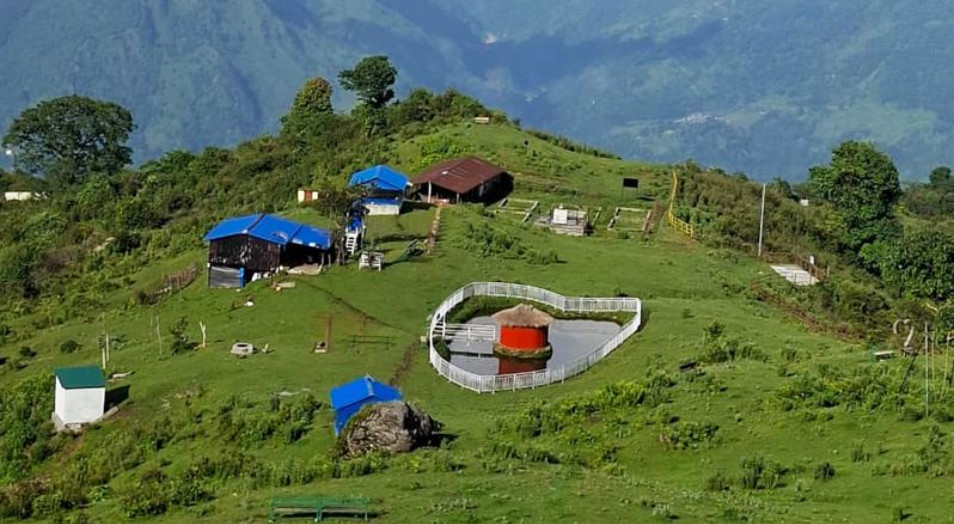
Harsingdanda, a scenic and historically significant hill in Marsyangdi Rural Municipality-3 of Lamjung, has emerged as a growing destination for domestic tourists in recent years.
Associated with the childhood of Nepal's national hero Bhakti Thapa, the hill attracts visitors with its sweeping Himalayan views, tranquil surroundings, natural beauty, and historical significance. Its tourism prospects have now received a further boost with the arrival of electricity.
The Nepal Electricity Authority's Lamjung Distribution Centre recently extended the national grid to Harsingdanda. As night falls and electric lights illuminate the hill, the once-dark settlement now takes on a new charm.
Residents, who had long relied on solar power for their basic electricity needs, now have access to a regular power supply. Locals believe the development will not only improve everyday life but also provide fresh momentum to tourism and local businesses.
Tourism development in Harsingdanda began gaining pace a few years ago when four local youths-Purna Bahadur Gurung, Suman Gurung, Suraj Gurung, and Indra Bahadur Gurung-jointly invested around Rs 1.1 million to develop visitor facilities. Their initiative included a conference hall with a capacity of up to 35 people, along with food and accommodation services.
The investment helped draw increasing numbers of domestic tourists to the historic hill. Today, hundreds of visitors arrive during different seasons to experience its natural and cultural attractions.
Locals expect improved infrastructure, particularly electricity, to create new economic opportunities. They hope tourism will increase demand for locally produced agricultural products and handicrafts, generate employment for young people, and stimulate economic activity in the village.
Harsingdanda offers panoramic views of the Manaslu range, Buddha Himal and Dr Harka Peak, as well as the winding Marsyangdi River, Ghalegaun, Kalmedanda, Besisahar Bazaar and, on clear days, as far as Bandipur in Tanahun.
Visitors are also drawn to the spectacular sunrise and sunset views. Combined with the peaceful atmosphere and local hospitality, the scenery has made Harsingdanda an attractive destination not only for day trips but also for overnight stays with friends and family.
Beyond its natural appeal, Harsingdanda holds an important place in Nepal's history.
Historical accounts state that Bhakti Thapa, born in 1802 BS at Dhungbensi in Khudi, now part of Marsyangdi Rural Municipality-3, spent much of his childhood grazing livestock on the hill. Local accounts also recall that he participated in traditional games and grew up amid the rural surroundings of Harsingdanda.
Bhakti Thapa later became one of Nepal's most celebrated military commanders and is recognised as a national hero for his role in the country's military history.
Initially associated with the Kingdom of Lamjung, he later played an important role in Nepal's territorial expansion and military campaigns, including operations in Jumla. His most celebrated contribution came during the Anglo-Nepal War, particularly on the western front at Deothal.
Historical accounts record that Bhakti Thapa commanded Nepal's western defence from Malaun Fort. With British forces occupying the strategically important Deothal position near Malaun, the western front came under severe pressure.
On April 16, 1815, the elderly commander led around 2,000 Nepali soldiers into battle against the British forces. Armed with traditional weapons and advancing under intense gunfire, he was killed in combat, leaving behind a legacy of courage and sacrifice.
Statues and memorial parks have been established in different parts of Lamjung in recognition of his bravery. However, Harsingdanda, the hill closely associated with his childhood, has only recently begun receiving greater attention as a destination of historical and tourism importance.
With the expansion of roads, electricity and tourism infrastructure, locals believe Harsingdanda is poised to attract more visitors in the years ahead.
For travellers, the hill offers a rare combination of panoramic landscapes, rural hospitality, and a connection to Nepal's heroic past. For the local community, the arrival of electricity represents more than light-it signals new possibilities for tourism, employment, and economic development.
© 2026 All right reserved to Nepalraibar English | Site By : Sobij