
As the monsoon paddy plantation season reaches its peak, farmers in Nawalparasi (Bardaghat Susta Purba) are increasingly turning to modern agricultural technology, replacing labour-intensive traditional methods with mechanized rice transplanting to address acute labour shortages, rising production costs, and climate-related challenges.
Although Nepal's agricultural sector still relies largely on manual labour, mechanization is gradually gaining momentum, particularly in the southern plains. Traditionally, paddy fields are ploughed and levelled using tractors or power tillers, while rice seedlings are transplanted by hand, a physically demanding and time-consuming task.
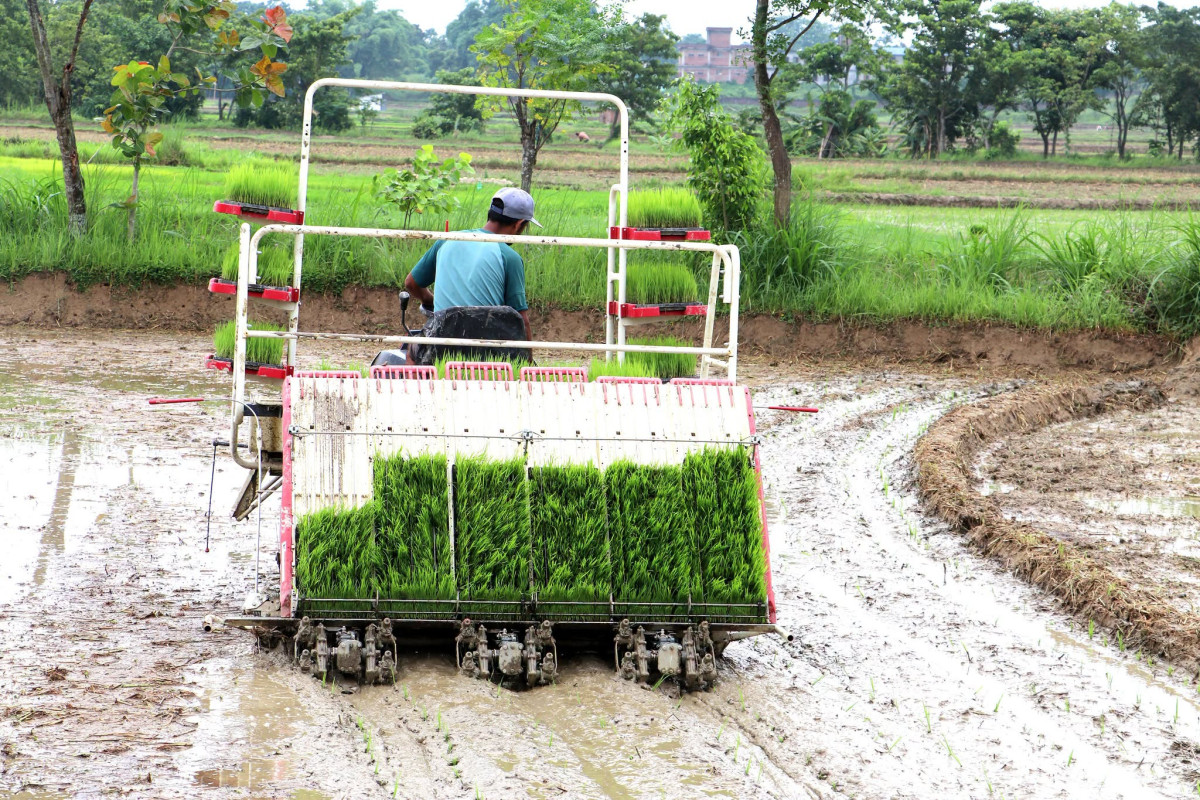
In Madhyabindu Municipality, however, an increasing number of farmers are now using rice transplanting machines, significantly reducing both labour requirements and the time needed to complete the plantation.
The rice transplanter, operated by the Prakriti Agricultural Cooperative Society in Madhyabindu Municipality-1, is capable of transplanting seedlings across large areas within a few hours, compared to an entire day or more under conventional manual methods.
Secretary of the cooperative, Om Prasad Pathak, said the technology has generated growing interest among local farmers due to its efficiency and cost-effectiveness.
"Farmers are encouraged after witnessing how quickly the machine completes the plantation. It saves both time and production costs," Pathak said. "Modern technology has made farming easier, and producers are becoming increasingly confident in agricultural mechanization because they can accomplish more work with fewer labourers."
Madhyabindu Municipality Mayor Bhim Lal Adhikari said the local government has prioritized agricultural mechanization as part of its broader strategy to commercialize farming and boost productivity.
According to him, the municipality provides agricultural equipment, including rice transplanters, combined harvesters, and agricultural ambulances, with an 85 percent subsidy to encourage farmers to adopt modern farming practices and remain engaged in agriculture.
He expressed confidence that such support would not only increase agricultural production but also attract young people to the sector.
Farmers' groups across the district have also been accessing modern machinery through the National Agriculture Modernization Programme Implementation Unit.
Agricultural economist Sanjay Dhakal of the Agricultural Development Office said paddy cultivation is carried out on approximately 19,000 hectares of land across Nawalparasi (Bardaghat Susta Purba).
He noted that the adoption of modern agricultural machinery has increased markedly since last year as farmers seek practical solutions to labour shortages, escalating cultivation costs, and increasingly unpredictable weather conditions.
"With labour becoming scarce, production costs rising and climate change creating new uncertainties, the use of modern technology is no longer an option but a necessity for sustainable rice farming," Dhakal said.
© 2026 All right reserved to Nepalraibar English | Site By : Sobij