
In a lecture hall at Shanghai's Fudan University, the traditional classroom is being redefined. Instead of solving algorithms for the final examination in a data mining course, students are asked to write original, complex questions designed to challenge advanced artificial intelligence (AI) models such as Claude and DeepSeek. According to a report published by Fudan University, the more difficult it is for the AI to answer the questions, the higher the student's grade.
"Traditional testing methods are facing new challenges in the age of AI," said Professor Xiao Yanghua, who teaches the course. "If we ask students to solve a standard algorithm, AI will always be faster. We must move toward training students to evaluate, guide, and identify the structural weaknesses of these models."
As educators around the world continue debating the role of AI in education, China is rapidly moving beyond experimentation toward a nationwide, systematic implementation. Under its national "AI Plus Education" strategy, the country aims to establish a comprehensive AI-driven education system across all levels of learning by 2030.
The vision is ambitious yet straightforward: China is not merely teaching students how to use AI, but also how to understand it, critically evaluate it, and collaborate with it. The goal is to prepare future generations to harness AI's transformative potential while navigating its ethical, technical, and societal challenges.
Empowering Classrooms from Primary Schools to Vocational Education
Across China's education system, AI is evolving from a subject of study into an active learning partner.
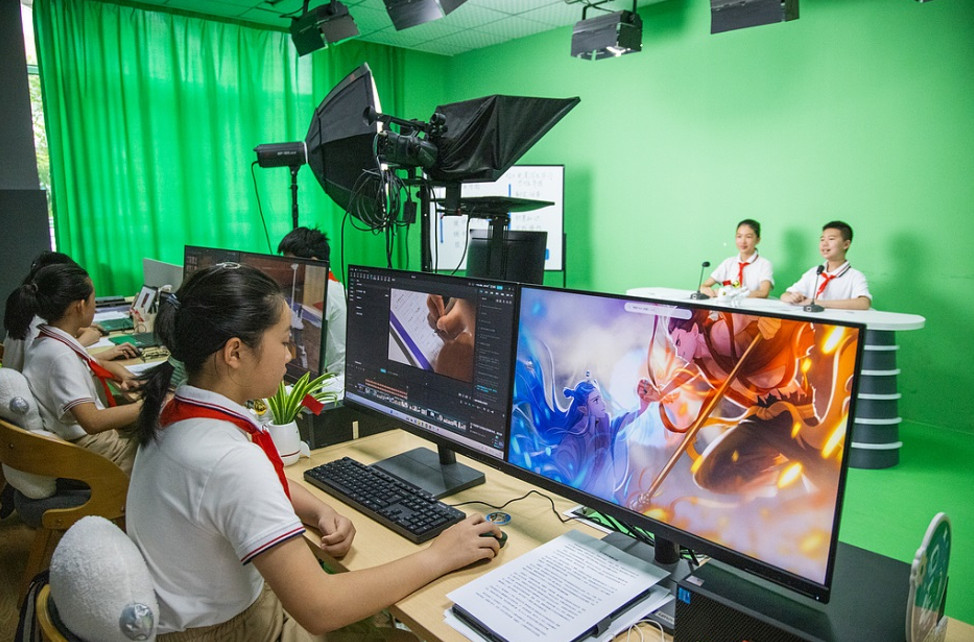
At Fendou Primary School in Beijing, teachers use AI-generated interactive 3D models that allow students to rotate and disassemble geometric shapes, transforming abstract mathematical concepts into engaging, hands-on learning experiences.
At Beijing No. 13 High School, AI agents analyze students' digital learning footprints to generate personalized "learning health reports." These insights enable teachers to replace one-size-fits-all homework with targeted assignments tailored to each student's strengths and weaknesses.
Meanwhile, Beijing No. 35 Middle School has introduced an AI-powered coding assistant capable of identifying programming errors in less than two minutes. By significantly reducing grading time, teachers can devote more attention to individualized instruction and mentorship.
AI is also reshaping vocational education. At Shandong College of Tourism and Hospitality, an AI-powered digital assistant named "Baize" simulates real-world hotel reception and guest service scenarios, allowing students to practice working alongside AI in realistic virtual environments before entering the workforce.
Addressing AI's Limitations and Risks
Chinese educators acknowledge that while AI is a powerful educational tool, it remains far from perfect.
Although AI systems excel at pattern recognition and data processing, they continue to struggle with distinctly human capabilities such as assessing creativity, interpreting complex reasoning, exercising ethical judgment, and safeguarding privacy.
Recognizing these limitations, China is simultaneously building the institutional framework needed to support responsible AI integration.
AI literacy is now being incorporated into national teacher qualification examinations, reflecting a shift in educators' roles from simply using technology to becoming digital leaders who can guide students' intellectual, ethical, and creative development in an AI-driven world.
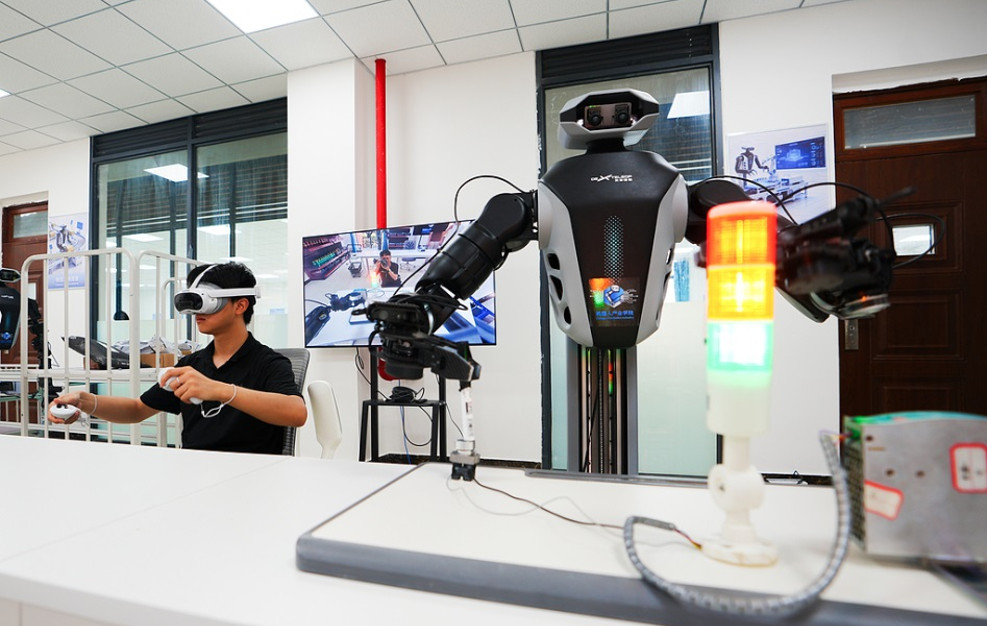
On June 30, 2026, AI-powered education enables students at Sichuan University of Science and Technology to use robots for simulated circuit testing. [Photo: CFP]
To reduce disparities in educational resources and prevent data fragmentation, Beijing's Xicheng District has connected 90 pilot schools with leading universities and technology companies. The initiative provides a controlled environment for developing, testing, and sharing AI-powered teaching tools while maintaining strict oversight.
Cultivating Adaptable Minds for an AI-Driven Future
Ultimately, China's educational transformation extends beyond technology itself. It is fundamentally about preparing students for an increasingly unpredictable labor market shaped by rapid technological change.
Speaking at a press conference in April, Fudan University President Jin Li argued that the ideal graduate in the AI era should resemble a "stem cell"-someone with the flexibility to move across disciplines, continuously acquire new knowledge, and adapt as existing technical skills become outdated.
This philosophy reflects a broader shift in educational priorities. Classrooms are no longer viewed merely as places for memorization and standardized instruction. Instead, they are becoming laboratories for human-AI collaboration, where students learn not only to use intelligent systems but also to question them, direct them, and recognize their limitations.
By cultivating critical thinking, interdisciplinary learning, and the ability to identify the structural flaws of AI systems, China is striving to ensure that human intelligence, not artificial intelligence, remains the guiding force shaping the future of technology.
© 2026 All right reserved to Nepalraibar English | Site By : Sobij