
Farmers in Siraha district are increasingly adopting climate-resilient agricultural practices, transforming their livelihoods and reducing vulnerability to erratic weather patterns.
Pramod Kumar Mandal, a farmer from Laxmipur Patari Rural Municipality–4, recalls struggling for years due to prolonged drought, unseasonal rainfall, and declining groundwater levels. Dependent on rain-fed agriculture, he often faced crop losses from both excessive and insufficient rainfall.
However, Mandal has now shifted to climate-friendly farming techniques, abandoning traditional methods. By adopting mulching technology and drip irrigation systems, he has significantly improved productivity and income.
“Earlier, it was difficult to manage the costs of seeds and fertilisers due to poor yields. Now, production has increased, and I feel relieved after changing my farming practices,” Mandal said.
His family now earns a steady income from vegetable farming, producing cauliflower, tomatoes, mushrooms, and other greens. Over the past six months alone, the family has earned nearly Rs 120,000. Mandal has also reduced reliance on chemical fertilisers by preparing organic alternatives and has installed a tunnel and solar-powered irrigation system to support cultivation.
Similarly, Anita Mahato of Dhangadhimai Municipality–10 has earned more than Rs 100,000 from vegetable farming in a single season. Encouraged by the success, her husband has returned from foreign employment to join her in agriculture.
Farmers say the use of solar irrigation has reduced dependency on electricity and fuel, while tunnel farming protects crops from hailstorms and extreme temperatures. “This has increased our income and strengthened self-reliance,” said a local farmer.
The transition has been supported by the National Farmers Group Federation Nepal through a climate-friendly village project implemented with financial and technical assistance from CARE Nepal.
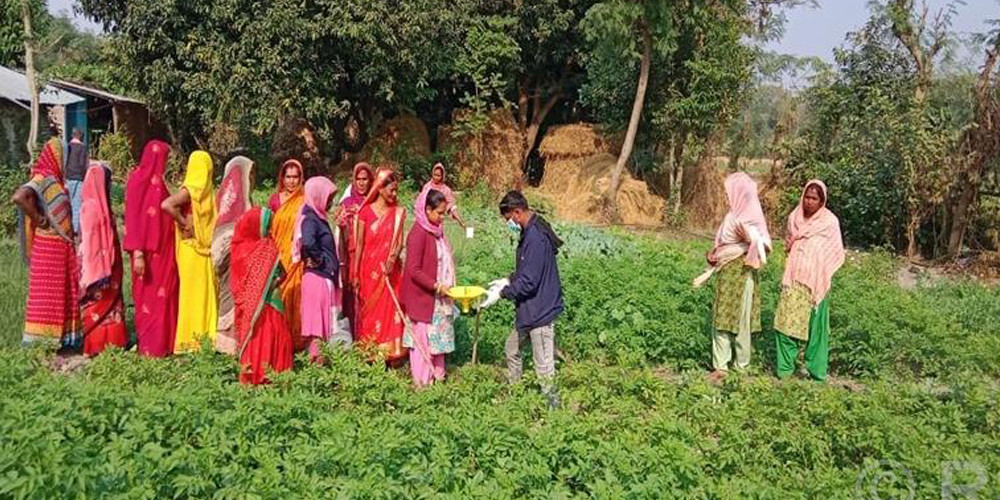
Field Supervisor Umesh Nandan Chaudhary said the programme includes farmer training, distribution of agricultural tools, and promotion of soil conservation techniques. Women’s farmer groups have been formed across multiple wards, along with the distribution of improved cooking stoves and climate-resilient seeds.
According to Senior Programme Officer Ishwor Thapa, the project is being implemented in several local levels in Siraha and Saptari districts, including Laxmipur Patari, Dhangadhimai, Bhagawanpur, Sakhuwanankarkatti, Rupani, and Agnisair Krishnaswaran.
“The main objective is to build climate-resilient farming communities, reduce greenhouse gas emissions, and empower women by lowering their workload,” Thapa said. The initiative follows a cost-sharing model, with 70 percent support from institutions and 30 percent contribution from farmers.
So far, 93 groundwater irrigation systems have been installed, benefiting over 500 households, while around 500 women’s groups are actively engaged in the programme.
Efforts are also being made to strengthen market access. Local farmer groups have initiated collective marketing strategies, ensuring fair pricing and promoting organic produce. “Consumers now recognise vegetables from these areas as chemical-free and safe,” Thapa added.
Experts note that climate-friendly agriculture focuses on efficient water management, soil health improvement, and the use of adaptive seeds. According to Thapa, such practices can reduce production costs by 30 to 40 percent while ensuring stable yields even under adverse weather conditions.
The government has also prioritised climate-resilient agriculture under its recent governance reform agenda, highlighting the need to improve soil carbon content to enhance moisture retention, soil fertility, and overall ecosystem balance.
For farmers long affected by drought and pests, climate-smart agriculture is proving transformative. While the technologies are yet to reach all farmers, the success stories are encouraging wider adoption across the region.
© 2026 All right reserved to Nepalraibar English | Site By : Sobij