
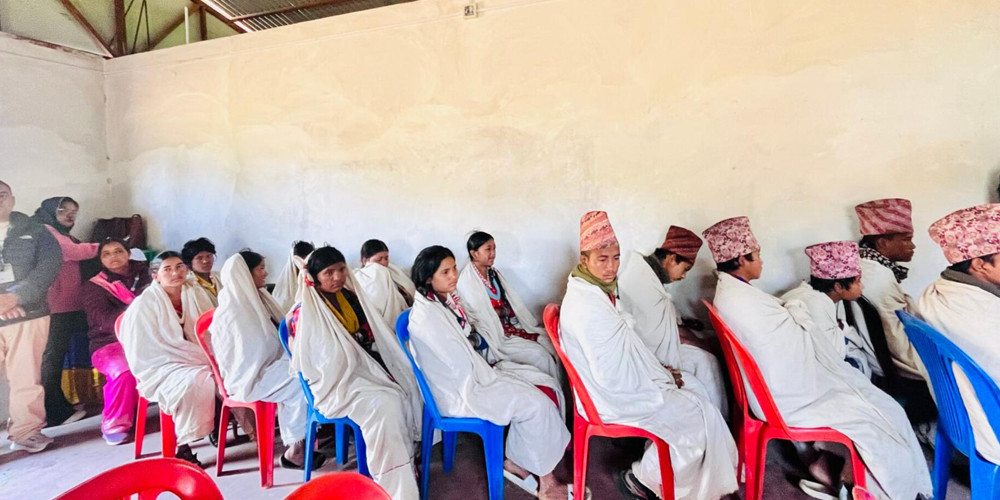
Youths from the nomadic Raute community have participated in a first aid training program organized in Surkhet. A total of 15 Raute youths-eight women and seven men-took part in the training.
According to the Ministry of Social Development of Karnali Province, the Raute community follows a nomadic lifestyle and resides across Surkhet, Dailekh, Jajarkot, and Salyan districts. The population of the community, currently estimated at 1,033, has been gradually declining in recent years due to changes in lifestyle, particularly in food habits and cultural practices.
At present, the Raute community is living in the forest area of Lekbensi Municipality-7 in Surkhet district.
The training was conducted by health workers from the Nepal Red Cross Society, Surkhet Chapter. Chairperson of the chapter, Ram Lal Acharya, said the participants were provided with basic first aid skills through both theoretical instruction and practical exercises.
The training aims to raise awareness among the Raute youths about injury management and the importance of providing emergency health support before transporting injured persons to health facilities.
Minister for Social Development of Karnali Province, Ghanashyam Bhandari, inaugurated the training on Tuesday. Emphasizing the need to preserve the Raute community, he said it is a shared responsibility to protect a group that holds a distinct identity in the province. He described the growing interest of Raute youths in health and medical care as a positive development.
“The Raute community has a unique civilization, language, and culture,” Minister Bhandari said, adding that the provincial government is committed to promoting socialization of the Raute people without undermining their traditional way of life. He informed that initiatives such as the establishment of a ‘Raute Corridor’ and formulation of a ‘Raute Policy’ are in the pipeline.
He further assured that while connecting the Raute community to modern practices, their cultural identity and traditional lifestyle would not be compromised.
Speaking at the program, Maythe or of Gurans Rural Municipality, Top Bahadur BC, said that identity cards and social security allowances have already been provided to members of the Raute community. He added that the local government has initiated efforts to facilitate the issuance of citizenship certificates, with proposals already submitted to the district administration office.
Similarly, Hira Singh Thapa, Executive Director of the Social Service Centre, a non-governmental organization, noted that the Raute community is increasingly inclined toward modern medical treatment. He said the first aid training would be beneficial, as reliance on traditional household remedies has at times complicated medical treatment.
© 2026 All right reserved to Nepalraibar English | Site By : Sobij