
The movie ‘gaun ayeko bato’, reminded me of the flurry of past memories. I remembered the song ‘Gaun gaun bata utha, basti basti bata utha…” a revolutionary song sung by Jhapalis during the 1970s when they were fighting against the monarchy. Today we have done away with monarchy but our gaun (village) is getting empty with no one to sing the song “gaun gaun bata utha…”!
The movie also reminded me of 'Shahid Marg (91 km)’ which was built by the Maoists during the People's War when I was working there. When I became a Minister of Physical Planning and Works (2007) after the PW I had allotted budget to that road. In the movie, I saw how building a motorable road had adversely affected the Rai culture and economy. I worried if the present metalled Shahid Marg had affected adversely to the Magars' way of life?
Being a janjati architect, I am aware of how careless development can jeopardize the Indigenous way of life affecting their 'gaans bas kapas'. I am not against development but it should be inclusive development.
During PW some efforts to integrate development with the indigenous way of life were practiced in Thawang village. Magars in Rolpa eat pork heavily, salad was introduced to digest and prevent constipation. Similarly, within their home, they reared pigs feeding the feces of humans directly. They made them separate pig breeding from their home. Earlier they were selling the hemp, Maoist helped them make rucksacks much in demand during PW.
In the movie, one could see how the local breweries were being replaced by Coca-Cola culture, and how the indigenous rooftop was being replaced by synthetic building material. And how indigenous underwear was being replaced by flashy synthetic lingerie.
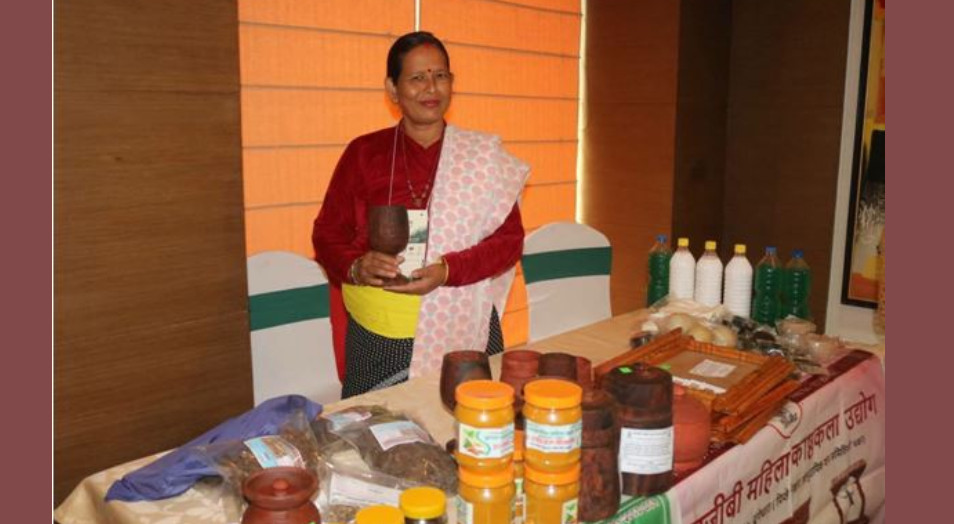
I had seen how the Karnali region was left out of development during monarchy era. On the positive side of development, I am also aware of how that region after the country became a republic and federal, is now flourishing as a separate province, getting basic amenities such as hospitals, universities, and road networks. It also has welcoming signs to see marshi rice, kodo (millet), honey, sishnu, from Karnali finding a market in Kathmandu malls. Seeing how fast indigenous 'gaans, bas kapas' were being replaced by consumerism I started worrying about the fate of Karnali province if the government did not protect their products.
Coincidently, 2/3 days after seeing the movie, I got to see a photo exhibition launched by Rashtriya Samachar Samiti (RSS) on the occasion of Republic Day displaying major infrastructure development works throughout the country. The first thing that struck me was the economic viability of these projects, secondly the participation and ownership of the projects by the local people, and thirdly, whether they will benefit the local people. If that was not taken into consideration then I was afraid Indian goods would flood the villages, with which we share almost 2\3 rd of our open border and have nearly 80 times bigger market than of Nepal.
While seeing the photos exhibition I got reminded of my 30 days trip from Chiwa Bhanjyang, Ilam district adjoining Sikkim, India to Jhulaghat, Baitadi district bordering Uttaranchal, India (Jan 29-Feb27, 2019) covering 28 districts in Pushpalal Marg, a mid hill highway. The salient feature of this road was that it covered all the janjati and khas community of the country.
The road is so strategic that, had the government given it first priority before the construction of Mahendra Rajmarg, migration from hills to Tarai would have been checked. After seeing the movie I became acutely curious during my recent 10 days trip from Ilam to Kanchanpur (June 27- July 7, 2024) covering 18 districts.
While traveling I saw almost no economic activities throughout the highway accept seeing children waiting for their school buses to reach private schools in the mornings and evenings. Suddenly it reminded me how remittance money has accelerated the flow of population from villages to small towns, and cities near highways. How it has flourished private English boarding schools in these cities. I remembered in the movie, ‘Papa’ being called again and again by the little son and how proud the father felt hearing English words from his son!
Lastly, would I say I was lucky to come back safely in Kathmandu, after 10 days of harrowing trip? I saw trails of the destruction of roads, houses, and paddy fields due to flooding and landslides killing people, and animals and destroying goods while returning back. At one point we became stuck in the middle of the road when we found a huge landslide blocking the road ahead and flooding of road behind us. We had to backtrack the road after the rain stopped. Once again I was reminded how in Thawang reforestation was taken up and check dams were built to save Thawang village from surrounding rivers during PW.
Unfortunately the same Maoist force who has been continuously in the government for the last 9 years have hardly been effective in implementing sustainable development work, instead they have been busy running after the power. (The writer is a politician and architect)
© 2026 All right reserved to Nepalraibar English | Site By : Sobij