Nepal highlights youth-driven change, and calls for global action

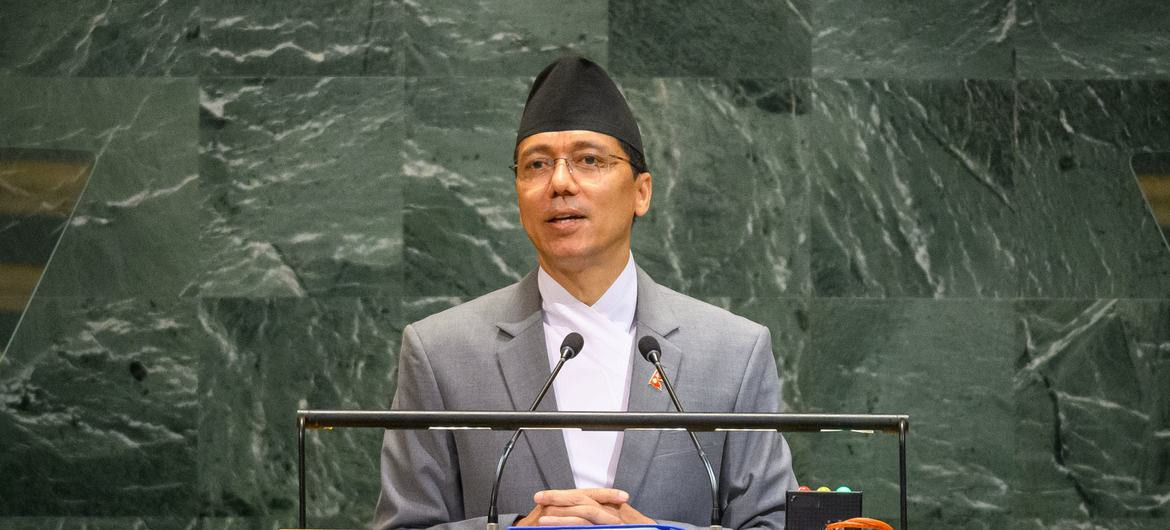
Nepal has called for renewed global commitment to peace, climate action, and inclusive development during the 80th session of the United Nations General Assembly (UNGA), stressing the urgency of strengthening multilateralism at a time of global crises.
Addressing the General Debate on Monday, Nepal’s Permanent Representative to the UN, Lok Bahadur Thapa, highlighted Nepal’s political transformation following the recent Generation-Z protest movement and reaffirmed the country’s dedication to democracy and good governance.
“Earlier this month, Nepali youth, particularly Generation Z, took to the streets with a clear and compelling call for change,” Thapa told world leaders. “Their demands were not for narrow interests, but for a nation built on the pillars of good governance, transparency, accountability, and responsiveness to the people.”
He noted that Nepal is entering a “new political phase,” with the country now led by Prime Minister Sushila Karki, the first woman to hold the post and a former Chief Justice. Nepal will hold its next general election on March 5, 2026, he said, adding that the government is focused on restoring trust, healing divisions, and strengthening democratic institutions.
Statement by H.E. Lok Bahadur Thapa
Permanent Representative of Nepal to the United Nations, General Debate of the 80th Session of the UN General Assembly
Mr. President, Excellencies, Distinguished Delegates,
It is my honor to address this august Assembly. At the outset, I extend warm greetings from the land of Sagarmatha, Mount Everest, the highest peak on Earth, and the birthplace of Lord Buddha, the apostle of peace and compassion. I congratulate Her Excellency Annalena Baerbock on her election as President of the 80th Session of the General Assembly and assure her of Nepal’s full support. I also express appreciation to Secretary-General António Guterres for his steadfast leadership during these challenging times.
Mr. President,
Allow me to share recent political developments in Nepal. Earlier this month, Nepali youth, particularly Generation Z, took to the streets with a clear and compelling call for change. Their demands were not for narrow interests, but for a nation built on the pillars of good governance, transparency, accountability, and responsiveness to the people. They called for efficient public service, an end to corruption, social justice, and dignified opportunities for youth.
While the movement reflected the aspirations of a new generation, it was not without tragedy. Violence claimed lives and left deep scars on our society. In the wake of these events, Nepal has entered a new political phase. For the first time in our history, the country is led by a woman Prime Minister-herself a former Chief Justice. General elections are scheduled for March 5, 2026, marking another step in strengthening our democracy through the fresh mandate of the sovereign people. Building trust, healing divisions, and restoring institutions will require time, resources, and solidarity.
Excellencies, Nepal stands at a historic crossroads. We know that the only viable path forward is the path of peace, democracy, and inclusive development. We are determined to continue our democratic journey and deeply value the goodwill and support of the international community as we move ahead.
Mr. President,
The world too stands at a crossroads. Peace is in peril. Militarization is mounting. Development is drifting. The climate crisis is deepening. Commitments have been broken, and promises remain unfulfilled. Against this backdrop, the theme of this session-“Better Together: 80 Years and More for Peace, Development and Human Rights”-could not be more relevant.
For eighty years, the United Nations has been the foundation of multilateralism, where nations large and small stand equal and work toward common solutions. It has been a beacon of hope for peace, prosperity, justice, human rights, and a rules-based international order. Today, as crises converge-from climate catastrophe to violent conflicts, the beacon must shine brighter than ever.
Mr. President,
Nepal attaches profound and enduring value to the United Nations. The UN Charter remains the bedrock of our foreign policy and a compass guiding our actions on the global stage. This year marks the 70th anniversary of Nepal’s membership in the UN. For seven decades, Nepal has consistently stood by, contributing to global peace and stability, advocating for a rules-based order, promoting equitable and sustainable development, and upholding human dignity and justice.
Nepal is proud to be among the largest contributors of troops to UN peacekeeping operations. Our professional peacekeepers have served with courage and dedication to secure peace in conflict-ridden regions across the world. We remain a steadfast advocate for complete and general disarmament, condemning terrorism in all its forms and manifestations, and standing for the protection of innocent lives everywhere.
As the current Chair of the Global Coordination Bureau of the Least Developed Countries (LDCs), Nepal is working to ensure equitable, inclusive, and sustainable development guided by the principle of “leaving no one behind.” As co-facilitator of the Fourth International Conference on Financing for Development, Nepal has been engaged in catalyzing investment for sustainable development, addressing the debt crisis, reforming the international financial architecture, and revitalizing multilateral cooperation. We are also honored to serve as President of the Economic and Social Council (ECOSOC) for this session, where we are committed to delivering results with coherence, credibility, and measurable impact.
Mr. President,
The world faces challenges of profound gravity and urgency. War continues in Ukraine. Human suffering deepens in Gaza, where civilians bear the heaviest toll. Nepal supports a two-state solution, where Israel and Palestine coexist peacefully and securely within internationally recognized borders, in line with relevant UN resolutions. We call for the immediate release of all hostages, including Bipinoi, a Nepali student held by Hamas since October 7, 2023.
Crises in Sudan, the Sahel, and beyond have left millions displaced and vulnerable. Global defense budgets are soaring, reaching a record $2.7 trillion in 2024, while development cooperation shrinks. Human rights are violated in many parts of the world. Climate-driven disasters are compounding human suffering and displacing entire communities. Multilateral institutions designed to uphold peace and dignity are under immense strain. Confidence in multilateralism is weakening. This is a clear call to reassess, strengthen, and revitalize our collective institutions.
Mr. President, allow me to highlight key areas requiring urgent action:
First, Peace and Security.
Peace demands action, courage, and commitment. Dialogue must triumph over hostility, diplomacy over conflict, and cooperation over division. We must address the root causes of conflict, including poverty, inequality, and marginalization.
Second, Multilateralism and Trust.
Multilateral institutions must deliver results, not just promises. They must be representative, transparent, and accountable. In an interdependent world, no nation, however powerful, can solve global problems alone.
Third, Sustainable Development.
Progress on the 2030 Agenda is far off track. We must act with urgency and solidarity. Development finance must be adequate, predictable, and aligned with national priorities. Trade systems must be reformed to be fair and inclusive. The debt burden of developing nations must be addressed through relief, restructuring, and innovative mechanisms.
Fourth, Climate Action and Justice.
Climate change disproportionately affects vulnerable countries, especially mountainous nations like Nepal. Our glaciers are melting, threatening the lives of millions downstream. Earlier this year, Nepal convened the Sagarmatha Sambad, the Everest Dialogue, under the theme “Climate Change, Mountains, and the Future of Humanity.” We adopted the Sagarmatha Call for Action, reaffirming our commitment to the Paris Agreement and the 2030 Agenda for Sustainable Development. By 2035, Nepal aims to reduce emissions by 27 percent and expand renewable energy eightfold. We call for urgent, fair, and ambitious global action, scaled-up climate finance, technology transfer, and capacity building for frontline countries. The Loss and Damage Fund must be fully capitalized, and biodiversity finance must increase to match the scale of the crisis.
Fifth, Digital Transformation.
Technology must be inclusive, secure, and rights-based. We advocate for a global framework to ensure equitable access to digital infrastructure, literacy, and data protection.
Finally, the United Nations itself must be reformed to reflect present-day realities. The Security Council must become more representative, transparent, and accountable. ECOSOC and the High-Level Political Forum must be strengthened to better deliver on the Sustainable Development Goals. The global financial architecture must be reoriented to meet today’s challenges.
Mr. President, for eight decades, the United Nations has stood as a beacon of hope for peace, justice, human rights, and development. Today, that legacy calls upon us more urgently than ever. The world watches us at a moment of great trial. Let us stand united and determined to ensure lasting peace and shared prosperity.
When the United Nations succeeds, humanity succeeds. When it falters, it is the innocent and vulnerable who suffer most. Let this 80th anniversary remind us of our shared duty to uphold peace, protect human dignity, and build a fairer, safer, and more sustainable world for all.
Nepal stands firmly committed to doing its part in shaping a safer, more prosperous, and more sustainable future.
Thank you.
© 2026 All right reserved to Nepalraibar English | Site By : Sobij