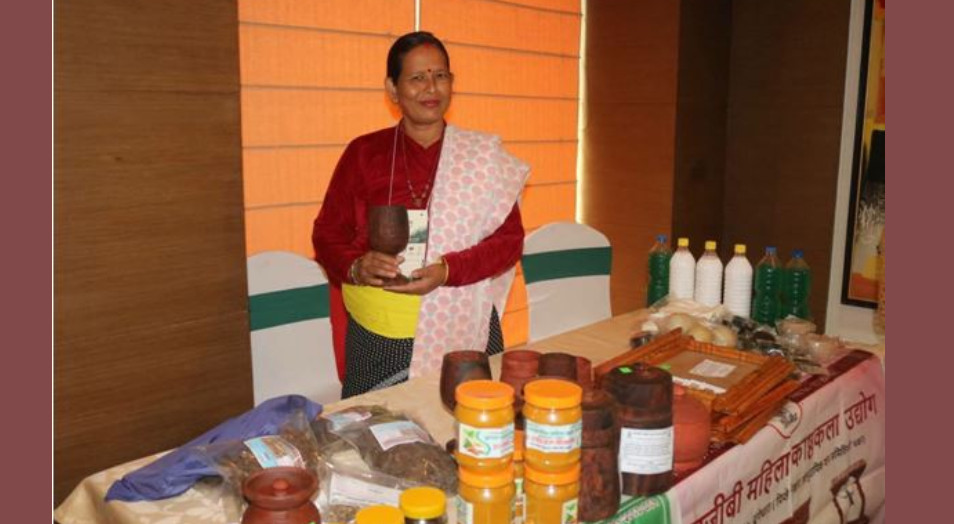


An industry has been established in Todke, a tourism site located at the border of Raghuganga and Mangala rural municipalities and Beni Municipality in Myagdi district, to produce biscuits using locally sourced crops.
With the support of the Gandaki Province Government and Raghuganga Rural Municipality, the Jhinka Farmers’ Group has launched the initiative to manufacture biscuits from indigenous grains, including millet, at the Todke Hill Resort and Homestay.
Man Bahadur Shermanjali, Chairperson of Ward No. 5 of Raghuganga Rural Municipality, said the trial production of biscuits using traditional grains such as millet, barley (uwa), and buckwheat has been successful.
“Millet biscuits have been produced on a trial basis using equipment provided by the municipality,” he said. “In the next phase, we plan to begin production using buckwheat and barley as well.”
The facility has been equipped with machines for grinding millet, buckwheat, and barley, as well as for processing and baking biscuits.
Situated at an altitude of 2,300 meters above sea level, Todke offers scenic views of the sunrise, rolling hills, and the Dhaulagiri and Annapurna Himalayan ranges. Bhim Sherchan, operator of Todke Hill Resort and Homestay, expressed confidence that the biscuit industry will help promote the use of indigenous crops while boosting tourism in the area.
In the fiscal year 2024/25, a project titled ‘Manufacturing and Branding Traditional Barley (Uwa)’ was launched to preserve and promote disappearing indigenous crops.
The project was implemented with a budget of Rs 7.5 million from the provincial government and Rs 2.5 million from Raghuganga Rural Municipality. As part of the initiative, barley and millet cultivation were expanded to an area of 300 ropani.
Under a 75 percent subsidy scheme, 67 farmers received agricultural equipment, including 30 mini tillers, 18 threshing machines, 19 combine harvesters, 82 brush cutters for barley, millet, and grass, a set of cookie production machines, 166 tarpaulins, 100 metal storage bins (each with a 300-kg capacity), and approximately 8,000 meters of pipeline.
Before equipment distribution, farmers were oriented on the importance of traditional grains like barley, millet, and buckwheat. They also received training in modern farming techniques and culinary use of these grains. Skill development sessions were conducted in local Jhinka hotels and homestays to teach the preparation of traditional dishes using barley and buckwheat.
© 2026 All right reserved to Nepalraibar English | Site By : Sobij