
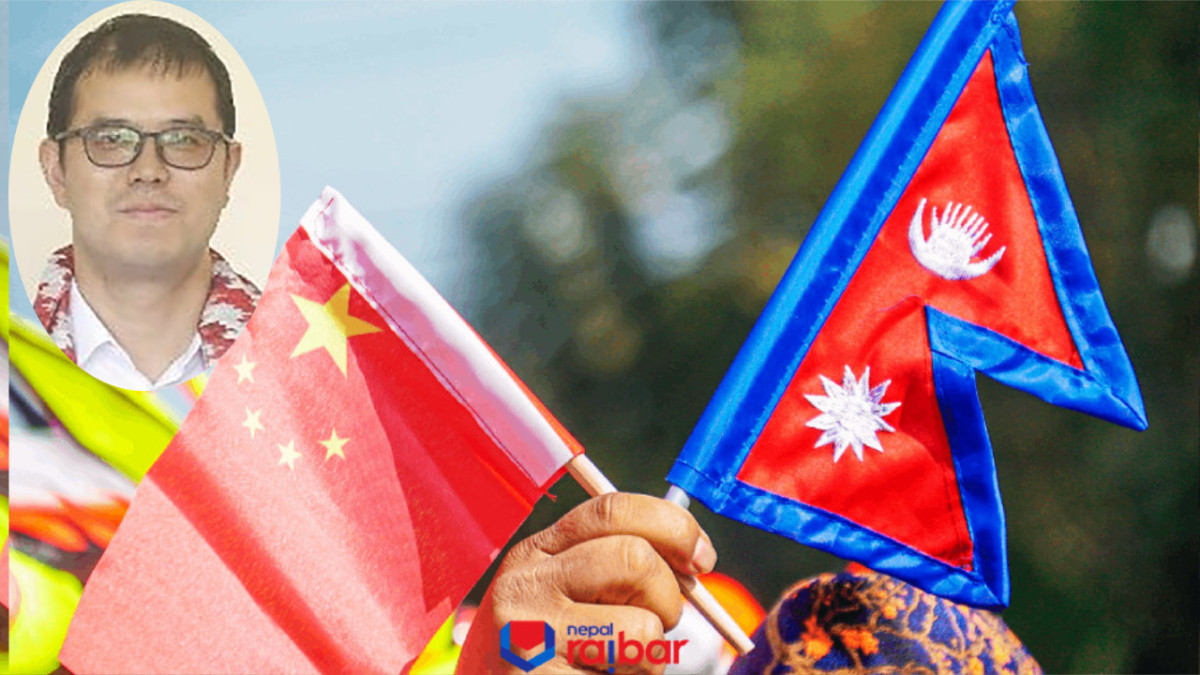
Professor Huang Zheng Duo, Director of the Nepal Study Centre at Sichuan University, China, has expressed deep admiration for Nepal’s natural beauty and cultural diversity, calling it his “second home.”
Duo, an expert in China-South Asia relations and a former student at the Johns Hopkins University School of Advanced International Studies in the United States, has authored three books and published numerous research articles. Currently in Kathmandu to participate in events marking the 70th anniversary of Nepal–China diplomatic ties, he sat down with Madhu Shahi for an exclusive interview.
Q: You visit Nepal frequently. What draws you back again and again?
A: I’ve visited Nepal more than 20 times, so I often say it’s like my second home. Initially, I came for academic research and to attend seminars and workshops. But what keeps bringing me back is Nepal’s breathtaking natural beauty.
I’ve explored places outside Kathmandu as well-Janakpur, Chitwan, Lumbini, Pokhara, and Manang. Each of these places has its own charm. Among them, Lumbini stands out as one of my favorites. It holds special significance as the birthplace of Lord Buddha. Since China shares a deep historical connection with Buddhism, Lumbini resonates strongly with many Chinese people, including me.
Q: Chinese tourists form a large portion of foreign visitors to Nepal. What improvements could Nepal make to attract even more?
A: Nepal has immense tourism potential. It’s home to stunning natural landscapes, UNESCO World Heritage sites, national parks, and of course, Mount Everest. Lumbini, in particular, is a spiritual destination for many Chinese tourists.
However, I feel there’s a lack of meaningful, spiritual souvenirs that visitors can take home from Lumbini. Tourists often struggle to find items that reflect the essence of their pilgrimage. Additionally, the cost of entry tickets to many sites in Nepal is relatively high compared to other countries. Offering concessions, especially to tourists from friendly nations, could encourage more visitors. I believe this would result in a notable increase in Chinese tourist arrivals.
Q: Recently, high-level visits between Nepal and China have increased. What impact do these have on bilateral relations?
A: High-level visits and diplomatic engagements are essential for building and strengthening bilateral ties. They deepen emotional bonds and create opportunities for long-term cooperation.
Beyond official diplomacy, people-to-people exchanges-such as student exchanges-are equally important. These help both societies understand each other better. Nepali students studying in China, for instance, are playing a vital role in fostering mutual understanding.
Q: As Nepal and China mark 70 years of diplomatic relations, how do you view the future of this partnership?
A: Nepal and China established diplomatic relations on August 1, 1955, and have built a strong foundation based on mutual respect, cooperation, and peaceful coexistence.
Now, the challenge is to make this partnership even more fruitful and future-oriented. For that, Nepal’s political stability is crucial. A stable government is key to implementing development plans and fostering long-term cooperation.
I see great potential in hydropower collaboration. Additionally, with the rise of artificial intelligence, digital partnership is another promising avenue. Nepal’s recent AI policy is a good step, and China can be a valuable partner in advancing Nepal’s digital capabilities.
Q: Of the various pillars of bilateral relations-political, economic, educational, social, and cultural-which do you believe is most effective?
A: All these aspects are interconnected and contribute collectively. However, I believe economic cooperation holds the key. Economic development creates a foundation that strengthens other sectors like education and culture. China is willing to share its experience with Nepal in poverty reduction and infrastructure development.
Q: Nepal has shown keen interest in China’s Belt and Road Initiative (BRI). What is your perspective on this?
A: Nepal is a landlocked country, so connectivity is vital. The BRI offers great potential to improve infrastructure and regional connectivity.
However, the pace of implementation has been slow, partly due to geopolitical challenges. All political parties in Nepal need to come together and prioritize development. Consensus is key to the successful execution of such major projects.
Q: Nepal lies between two large and powerful neighbors. How should it maintain a balanced relationship?
A: While Nepal is smaller in size, it has its own sovereignty and unique identity. Balancing relations between India and China can be challenging at times, but I believe it is achievable through goodwill and cooperation.
Nepal has shown diplomatic maturity in managing its external relations. As long as it maintains open dialogue and mutual respect with both neighbors, it can continue to play a positive, balancing role in the region.
Q: The number of Nepali students in China is growing. What role can they play in enhancing bilateral ties?
A: This is a very encouraging trend. These students act as cultural ambassadors. By engaging in academic exchanges, seminars, and training, they develop a deep understanding of Chinese society. This people-to-people connection is a strong foundation for long-term friendship between our countries.
Q: Finally, what aspect of Nepal do you find most beautiful?
A: Nepal is beautiful not just for its natural scenery, but also for its rich culture, religious diversity, and inclusive society. I especially admire the openness in debates and discussions here. Nepal’s multi-dimensional society and interactive culture are truly fascinating.
© 2026 All right reserved to Nepalraibar English | Site By : Sobij