
In my grandparents’ old house in a small village in eastern China’s Shandong Province, I found a handful of stained bullet shells lying quietly in a drawer. My grandmother, born in 1938, told me she had collected them as a child.
“After entering our village, the Japanese fired randomly at the houses,” she recalled. “My siblings and I hid under the bed, watching as bullets shattered our windows and fell to the ground.” She added that people were terrified, especially women: “I remember young women smearing pot ashes on their faces to look ugly, so they would not be raped by the Japanese.”
As she grew older, she kept the shells as personal reminders of Japan’s invasion of her hometown and of the people’s suffering and resistance, a story she later passed on to her children and grandchildren.
Ahead of the 80th anniversary of the victory in the Chinese People’s War of Resistance Against Japanese Aggression and the World Anti-Fascist War, I visited collectors of wartime relics to explore how China remembers its 14-year struggle.
A Crucial Battlefield
The war between Japan, an industrial power at the outbreak of WWII, and China, then an agrarian nation, was obviously lopsided. Many believed China was fighting a losing battle. Yet the Chinese army stood its ground.
In July 2025, I visited the former home of Commander Zhu Fuxing, who led his regiment in defending Shanghai against the Japanese invasion in August 1937. Zhu and his men fought the enemy back in several engagements, though two-thirds of his men were killed. As the Japanese launched wave after wave of attacks, Zhu held the line for seven straight days and nights without sleep until he was finally shot and lost consciousness. Three bullets pierced his chest, one stopping less than a centimeter from his heart. Surgeons removed two, but the last remained lodged in his lung for the rest of his life. The blood-soaked, bullet-riddled vest he wore that day is still preserved by his family as a symbol of his sacrifice and indomitable spirit.
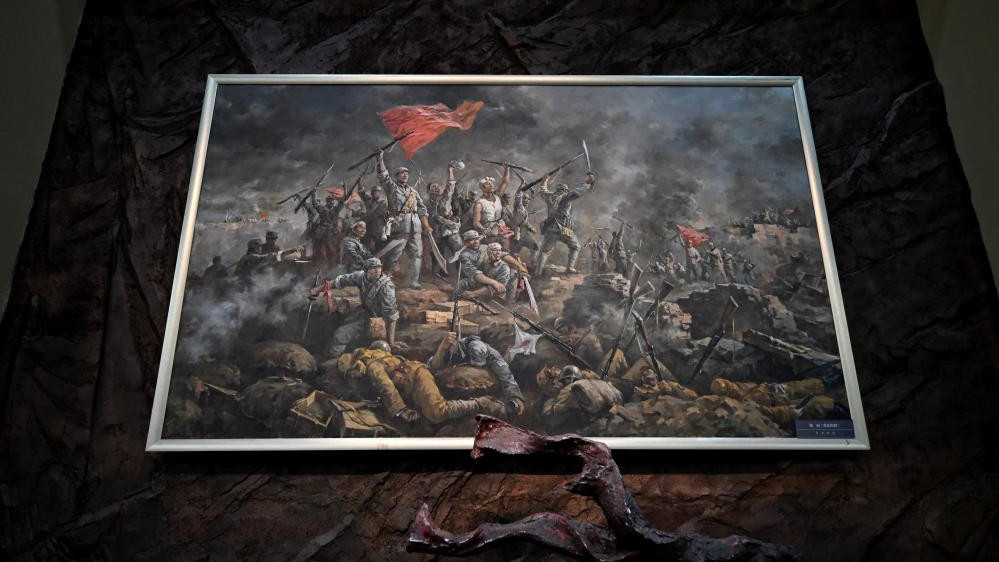
Internationally, the Battle of Shanghai became known as the “grinding mill of flesh and blood.” China committed more than 700,000 soldiers. In three months of brutal combat, nearly half were killed or wounded.
Despite the staggering losses, the battle shattered Japan’s illusion of conquering China in three months. It slowed Japan’s advance, delaying its plans to extend control both within China and across the wider world.
The impact went beyond China. As reports of the battle spread, it became clear that China was not just fighting for its own survival but also standing firm in a much larger global struggle. That realization helped galvanize support from countries such as the Soviet Union and the United States.
After Shanghai, China did not back down. Victories at Pingxingguan and Taierzhuang, the Hundred Regiments Offensive, and later battles in western Hunan all chipped away at Japan’s strength until final victory came within grasp.
The Ocean of People’s Fight
The way China names the war, the Chinese People’s War of Resistance Against Japanese Aggression, makes clear that this was a “people’s war.” And it truly was.
Album collector Yang Yong showed me some old records produced during the war. The songs they carried paid tribute to ordinary people contributing to the resistance efforts. One of them is The Song of the Great Road, which praises those who risked their lives building roads for transporting weapons, supplies, and soldiers.
One of the deadliest projects was the Yunnan-Burma Road. Stretching 1,100 kilometers from Kunming in Yunnan Province to Lashio in Burma, more than 80 percent of it winds through perilous mountain terrain. Workers faced dense forests, deadly diseases, and near-impossible conditions. American engineers insisted it could not be completed in less than three years.
Yet 200,000 ordinary people from over ten ethnic groups took up the task. Many were elders, women, and children, since the young men were already fighting at the front. Carrying their own food, armed with little more than picks and hoes, they worked day and night, completing it in just nine months.
This miracle came at a heavy cost. More than 3,000 workers lost their lives - roughly three for every mile of road completed. Some fell from cliffs, others drowned in rivers, and many succumbed to infectious diseases.
Soon after its completion, the road became China’s only overland lifeline to the outside world. Over the course of the war, nearly half a million tons of vital supplies flowed through it. Meanwhile, China exported non-ferrous metals to support the anti-fascist efforts of Britain, the United States, and others.
Like the road builders, civilians across China contributed in their own ways. In Ranzhuang, Hebei Province, villagers dug 16 kilometers of underground tunnels over several years, using them to repel Japanese puppet troops three times. In Shanghai, patriotic merchant Xiang Songmao worked tirelessly producing medicine for the front lines until he and eleven of his workers were executed by the Japanese. In Yan’an, northwestern China, farmers launched massive production drives to keep the anti-Japanese forces supplied.
All of these stories confirm that China’s war of resistance was truly a people’s war. Japanese invaders were engulfed in “the vast ocean of people’s fight,” and that ocean of resistance became a vital force in the global victory over fascism.
Anti-Fascist Efforts Continue
History shows that fascist movements often resurface in times of economic turmoil and social conflict. Therefore, the risk - whether large or small - remains that colonialism and militarism could rise again, that history could repeat itself, and that anyone could become a victim.
Although the guns fell silent eight decades ago, the struggle against fascism continues - but in different forms.
The Global Security Initiative proposed by China, for example, has emphasized the sovereignty and territorial integrity of all countries, helping to prevent the historical tragedy of fascist states seeking so-called “living space” through invasion and expansion. China’s Global Development Initiative, on the other hand, advocates for all countries to achieve development in a fair and inclusive environment, so that living standards will improve, societies will become more stable, and the extremist ideologies and behaviors bred by poverty and inequality will be reduced - thus weakening the soil from which fascism grows.
About eighty years on, the bullet shells still lie quietly in my grandmother’s drawer, piercing through time to remind us that the scars of fascism have not fully healed, nor has the danger disappeared. The shells will be passed down to my generation and the younger ones as both a memory and a warning. The world must remember that peace is never a given. It can only be built and defended through constant vigilance, international cooperation, and respect for all nations and peoples.
© 2026 All right reserved to Nepalraibar English | Site By : Sobij